6
Temperature is one of the most important factors affecting the development of annual killifish eggs stored in peat. In general, warmer conditions speed development and cooler conditions slow it down. But there is an important limitation: peat incubation cannot be calculated with a simple formula that works for every annual killifish.
Species, population, diapause stage, peat moisture, oxygen availability and the developmental history of the eggs all influence the final incubation period. The American Killifish Association therefore describes published incubation times as guidelines rather than fixed dates.
That means temperature can be used to adjust an expected incubation period, but it should not replace examination of the embryos.
Why Temperature Changes Incubation Time
Killifish embryos are ectothermic. Their developmental rate is strongly influenced by temperature.
As a general rule:
Higher temperature → faster development
Lower temperature → slower development
This relationship is well established in killifish breeding practice. The AKA reports that warmer conditions normally shorten incubation, while also warning that warmer and drier conditions can actually slow development.
This is particularly important with eggs kept in peat because temperature is only one part of the incubation environment.
Why There Is No Universal Formula
It is tempting to calculate incubation like this:
60 days at 24°C = 50 days at 26°C
Unfortunately, annual killifish eggs don’t behave that predictably.
Annual species have evolved diapause, in which embryonic development can temporarily stop. There can be several diapause stages, and embryos from the same spawning can develop at different rates.
Consequently, two batches of eggs stored at exactly the same temperature may not hatch on exactly the same day.
Even more importantly, different species and populations have different incubation requirements.
A Better Way to Think About Temperature
Instead of trying to calculate an exact hatch date, use temperature to establish a working incubation window.
For example, suppose the normal recommendation for a particular population is approximately:
60–75 days at 24°C
You can think of that as the baseline.
If the eggs are kept somewhat cooler, development may take longer.
If they are kept somewhat warmer, development may be faster.
But the correct question eventually becomes:
Are the embryos developed enough to hatch?
rather than:
Has the calculated number of days elapsed?
This distinction is extremely important with annual killifish.
A Practical Temperature Table
The following table is a general planning model, not a universal species formula.
| Incubation temperature | Expected effect | Practical approach |
|---|---|---|
| 20°C / 68°F | Slow development | Expect a longer incubation period |
| 21°C / 70°F | Slow–moderate | Use the long end of the species’ normal range |
| 22°C / 72°F | Moderate | Good conservative temperature |
| 23°C / 73°F | Moderate–fast | Development normally progresses faster |
| 24°C / 75°F | Fast | Useful baseline for many warm-water annuals |
| 25°C / 77°F | Faster | Monitor embryo development |
| 26°C / 79°F | Fast | Use only when appropriate for the species |
| 27°C / 81°F+ | Very warm | Do not assume faster is better |
The AKA’s general guidance places many annual killifish around 70–75°F (21–24°C) during peat incubation, while noting that some Nothobranchius breeders use temperatures approaching 80°F (27°C). Temperatures above about 80°F are specifically cautioned against in the AKA beginner’s guide.
The 10°C Rule Does NOT Apply
You may encounter general biological formulas based on Q10, where developmental rate approximately doubles for a 10°C increase.
This can be useful in laboratory biology for some organisms, but it should not be applied blindly to annual killifish eggs.
Why?
Because killifish development isn’t simply a continuously accelerating chemical reaction.
The embryo may enter:
- Diapause I
- Diapause II
- Diapause III
- periods of active development
- variable developmental trajectories
Temperature can influence whether and how quickly these stages are passed.
So a calculation such as:
Incubation time × temperature correction = hatch date
can give a misleading degree of precision.
A More Useful Method: Temperature Adjustment
Instead of a mathematical formula, use a baseline + adjustment system.
Suppose your species normally receives a recommendation of:
60 days at 24°C
You could use this as your reference.
At 24°C
Start checking around:
Day 50–55
and expect many eggs to become ready around the recommended period.
At 22°C
Expect development to take longer.
Start checking perhaps:
Day 60 onward
At 26°C
Development may be faster.
Begin checking earlier:
Around day 45–50
The exact numbers are deliberately approximate.
They are not a substitute for the published incubation recommendation for the particular species or population.
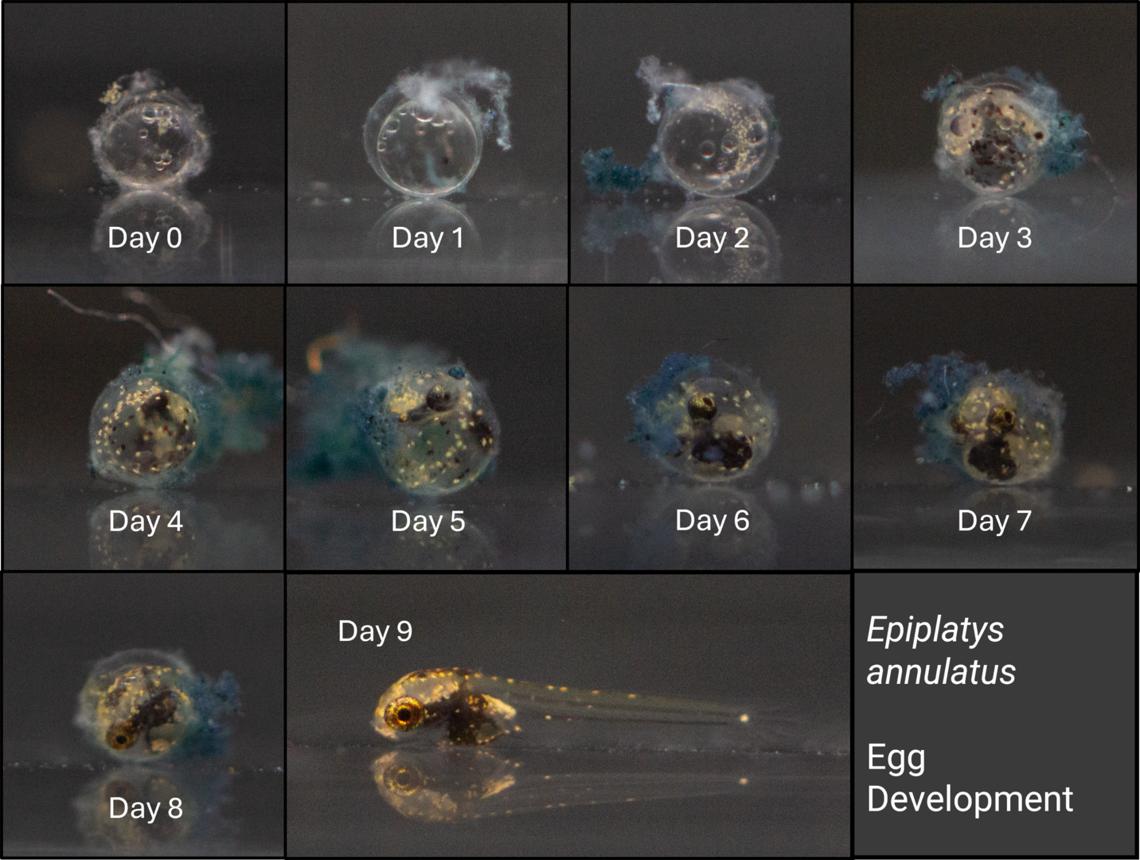
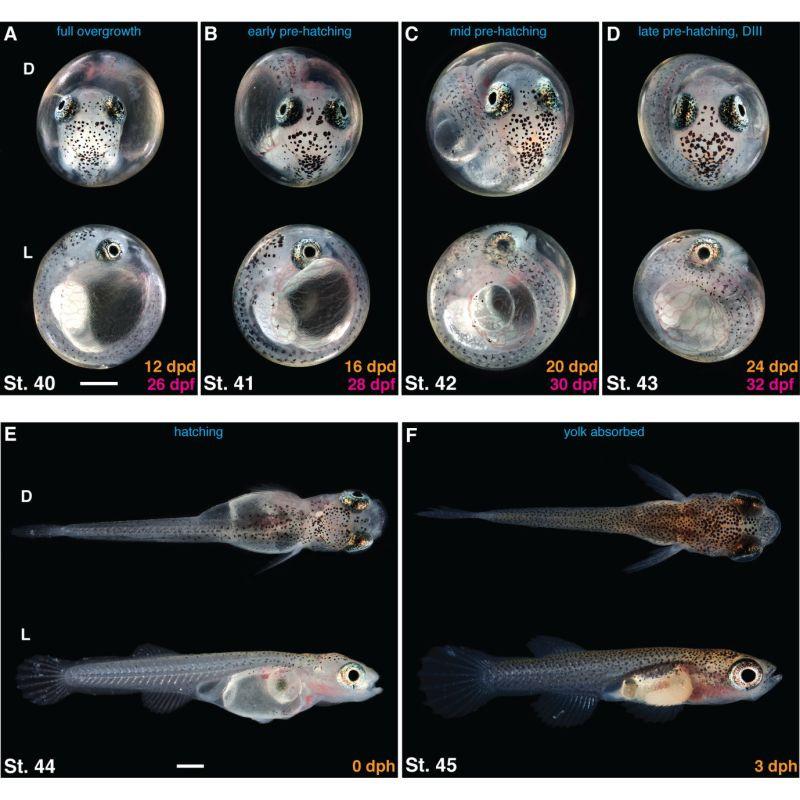
The Embryo Is Your Best Incubation Timer
4
This is one of the most important rules in annual killifish breeding:
Don’t rely exclusively on the calendar.
The embryos themselves provide better information.
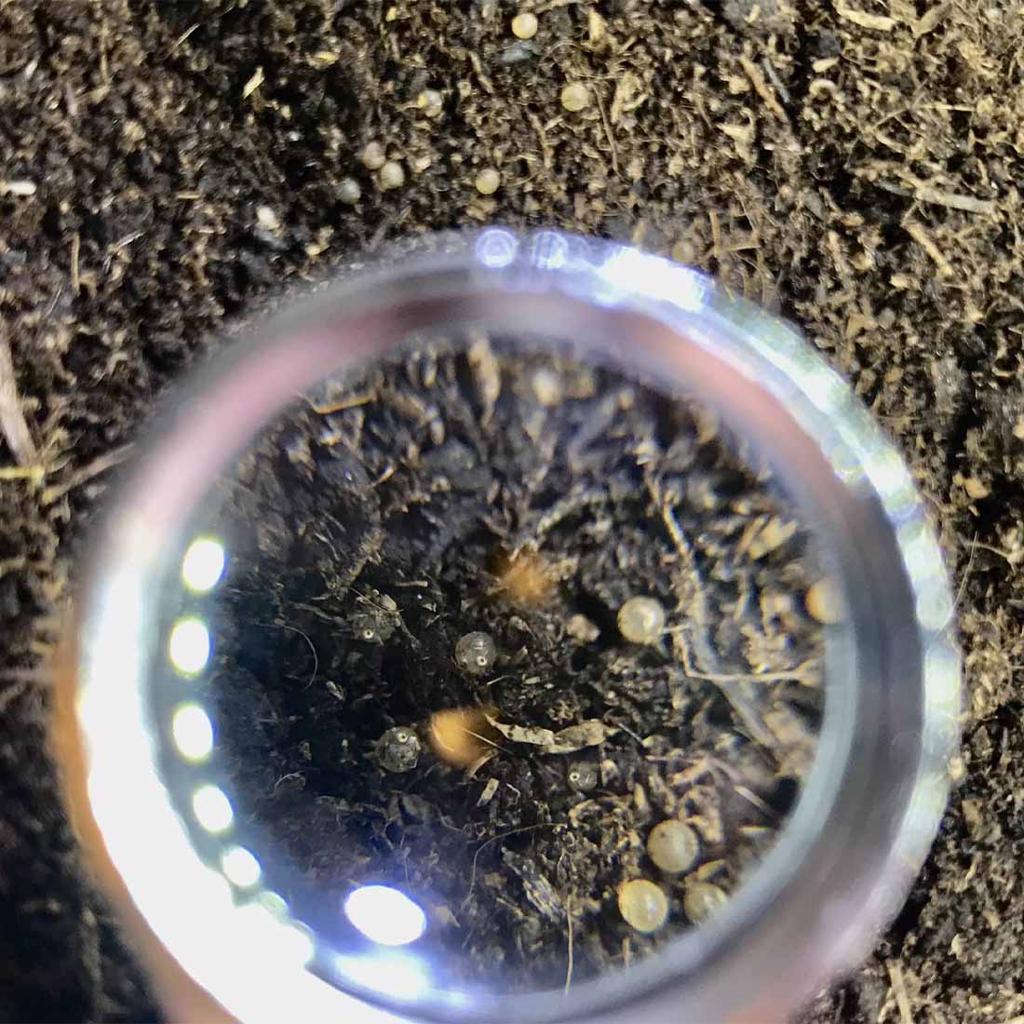
As development progresses, you can examine the eggs with:
- a hand lens
- magnifying glass
- bright flashlight
- low-power microscope
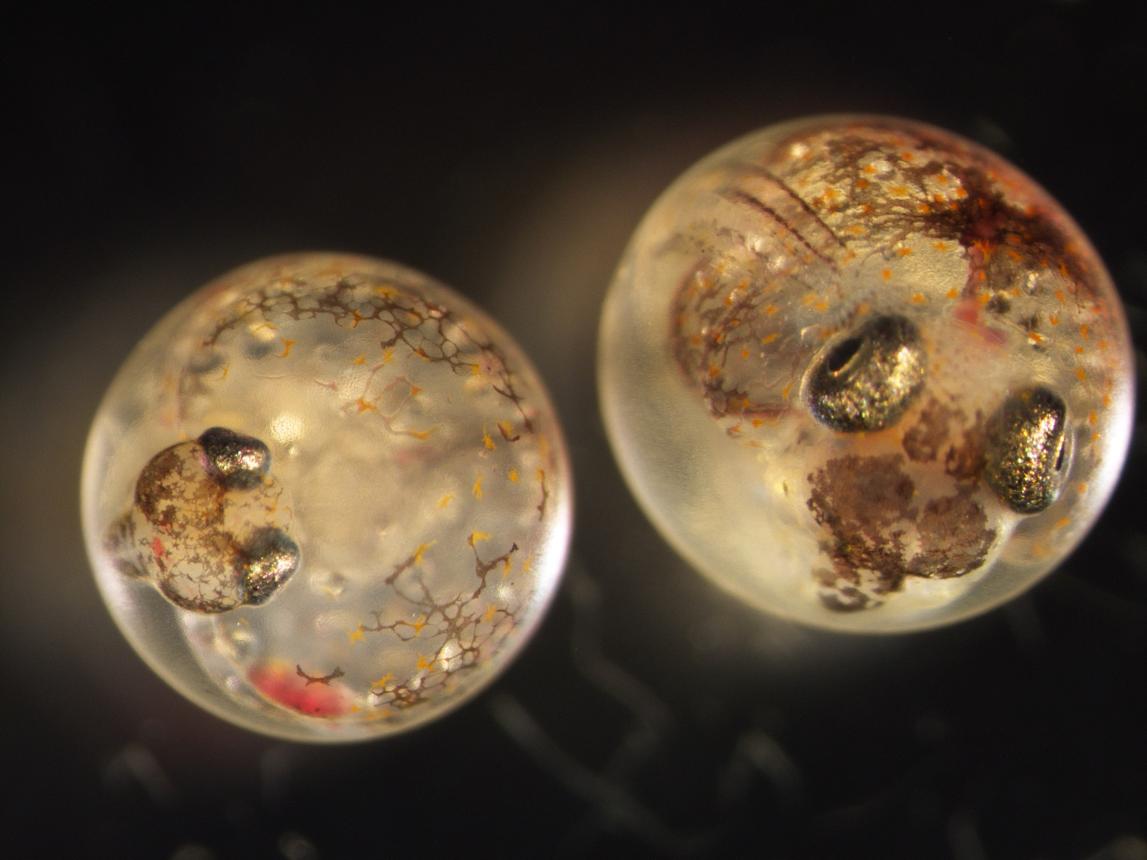
A fully developed embryo will generally show a clearly developed eye, often with a distinctive golden or dark ring around the eye. Movement of the embryo when exposed to strong light is another useful indication that development is advanced.
When most embryos have reached the appropriate developmental stage, the eggs may be ready for wetting.
Why Checking Too Early Can Be a Problem
If annual eggs are flooded before the embryos have completed the necessary development, the hatch can be poor.
Possible results include:
- no immediate hatch
- delayed hatching
- weak fry
- malformed fry
- belly sliders
- a later hatch after the peat is dried and stored again
The AKA specifically warns that wetting annual eggs too early can result in poor hatching or belly sliders.
Therefore:
The calendar tells you when to start looking.
The embryo tells you when to hatch.
Why Peat Moisture Complicates Temperature Calculations
Temperature isn’t working alone.
The moisture level of the peat can have a major influence on development.
Peat that is:
Too wet
can reduce oxygen availability.
Peat that is:
Too dry
can damage the eggs through excessive desiccation.
The AKA describes damp peat as useful for incubation and notes that warmer and wetter conditions can shorten incubation, while warmer and drier conditions may instead slow development.
This is one reason why two breeders can use the same temperature but obtain different incubation times.
Oxygen Also Matters
Annual killifish embryos are remarkably adapted to changing oxygen conditions.
During diapause, oxygen consumption can fall dramatically. Research on Nothobranchius korthausae found substantial changes in oxygen consumption during embryonic development and diapause.
This helps explain why incubation isn’t simply:
temperature → number of days
Instead, development depends on the interaction between:
temperature + moisture + oxygen + diapause + species + embryo history
Species-Specific Incubation Is Essential
6
Different annual killifish can have dramatically different recommended incubation periods.
For example, the AKA beginner’s guide gives approximately 60–75 days for many Nothobranchius under typical conditions, while other annual species may require considerably different periods.
The AKA also notes that some annual eggs may require several months, with certain species taking 8–10 months in some circumstances.
Therefore, never take a generic “annual killifish = X days” formula and apply it to every species.
Population Codes Matter
For serious annual killifish breeding, record more than the species name.
For example:
Nothobranchius rachovii
Beira 98/2
Collected: September 3
Peat collected: September 20
Incubation: 24°C
The locality/population code is important because different populations can have different reproductive and developmental characteristics.
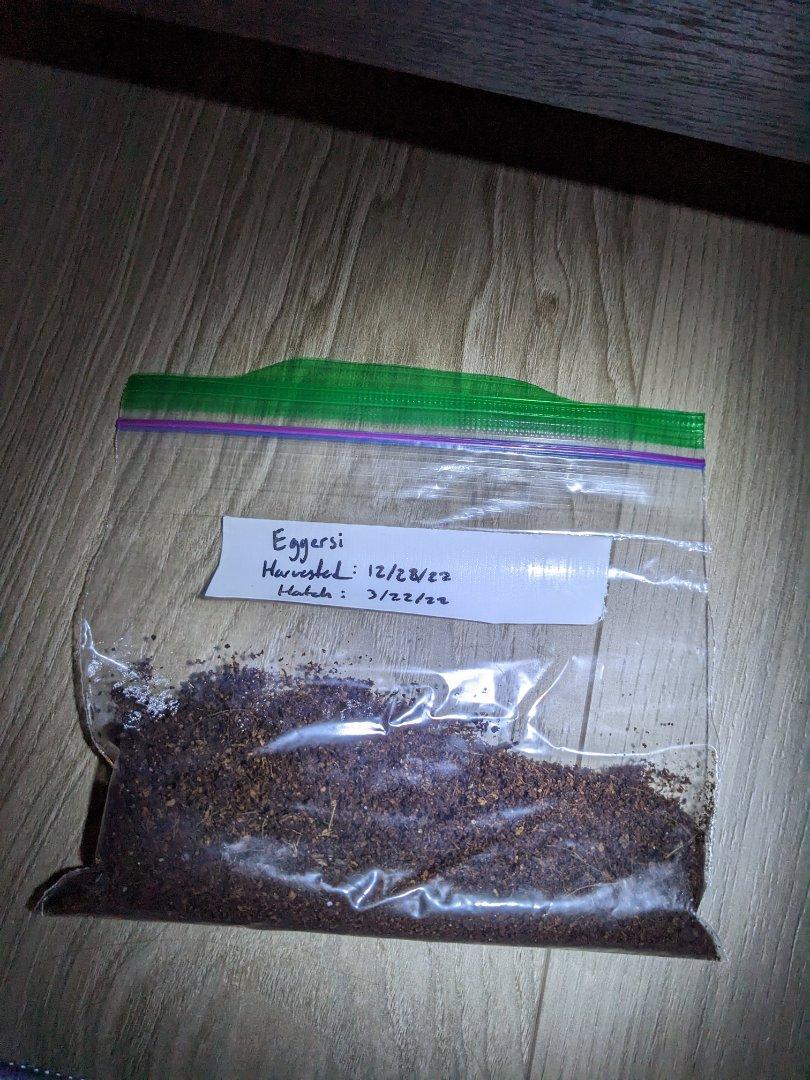
The AKA recommends recording the species, population or collecting code when applicable, collection date and other useful information on stored spawning material.
Over time, your own records become more valuable than a generic incubation chart.
Build Your Own Temperature Record
A simple breeding log can make incubation much easier.
| Batch | Temp. | Peat condition | Day eye-up observed | Hatch date |
|---|---|---|---|---|
| Batch A | 22°C | Damp | 68 | 72 |
| Batch B | 24°C | Damp | 55 | 60 |
| Batch C | 26°C | Damp | 48 | 53 |
After several generations, you may discover that your particular population consistently develops within a predictable range.
That is much more useful than trying to calculate an artificial exact date.
The Best Incubation Strategy
For a new annual species or population:
Step 1 — Find the published recommendation
Use information specific to the species/population whenever possible.
Step 2 — Record your actual temperature
Don’t simply write “room temperature.”
Record:
24°C
rather than:
warm room
Step 3 — Record the peat condition
For example:
damp, no free water
Step 4 — Start checking before the expected date
Don’t wait until the final day.
Step 5 — Examine several eggs
One developed embryo doesn’t necessarily mean the entire batch is ready.
Step 6 — Look for eye development
The embryo should be visibly advanced.
Step 7 — Wet only when appropriate
If most embryos appear ready, test a small portion if you have enough eggs.
A Useful “Temperature Ladder”
For breeders who want to experiment, a temperature ladder can be more informative than a theoretical formula.
For example:
22°C → slower baseline
24°C → normal baseline
26°C → faster development
Keep everything else as similar as possible.
After several batches, compare:
- days until eye-up
- days until first hatch
- percentage hatched
- number of belly sliders
- percentage of viable fry
- delayed hatch rate
This allows you to determine what actually works for your population.
Don’t Chase the Fastest Hatch
A common mistake is assuming:
Faster incubation = better incubation.
It doesn’t necessarily.
The objective is not to produce fry as quickly as possible.
The objective is:
healthy embryos → good hatch → strong fry.
Excessively high temperatures can be counterproductive, and the AKA specifically cautions against assuming that temperatures above about 80°F are beneficial.
For most hobby breeding situations, a stable, appropriate temperature is preferable to repeatedly changing the temperature in an attempt to accelerate development.
Temperature and Diapause
This is the part that makes annual killifish so different from ordinary egg incubation.
An annual killifish embryo isn’t necessarily developing continuously.
It may reach a developmental stage and pause.
During diapause, changing the temperature may not produce the simple acceleration that you would expect from a continuously developing embryo.
The natural purpose of diapause is survival through the dry period. Eggs from the same spawning can also develop at different rates, which contributes to staggered hatching when the environment becomes suitable.
This is why hatching a batch over several attempts is not necessarily evidence that something went wrong.
It can be part of the biology of the fish.
A Simple Calculation You Can Use
There is one calculation that is genuinely useful:
Average incubation temperature
If the temperature changes during the day, calculate the average rather than using only the daytime temperature.
For example:
Day: 25°C
Night: 21°C
Approximate average:
(25 + 21) ÷ 2 = 23°C
For more accurate records, use several temperature measurements throughout the day.
This gives you a better description of the actual incubation environment.
The Practical Rule
For annual killifish eggs incubated in peat:
Use temperature to estimate when to start checking, not to determine an exact hatch date.
The species/population’s known incubation range gives you the starting point.
Temperature tells you whether development is likely to be toward the faster or slower end of that range.
Peat moisture and oxygen modify the result.
And finally:
the embryo determines when the eggs are actually ready.
That is why experienced killifish breeders often regard incubation time as a judgement call rather than a mathematical calculation.
Quick reference
Cooler + appropriately damp → generally slower
Warmer + appropriately damp → generally faster
Too dry → development can be impaired
Too wet → oxygen availability can become a problem
Diapause → development may pause
Different species → different incubation periods
Different populations → potentially different results
Different eggs in one batch → potentially different developmental rates
Best indicator → embryo development, especially eye-up
And for a new population, your own incubation records are ultimately the most valuable temperature calculator you can have.
