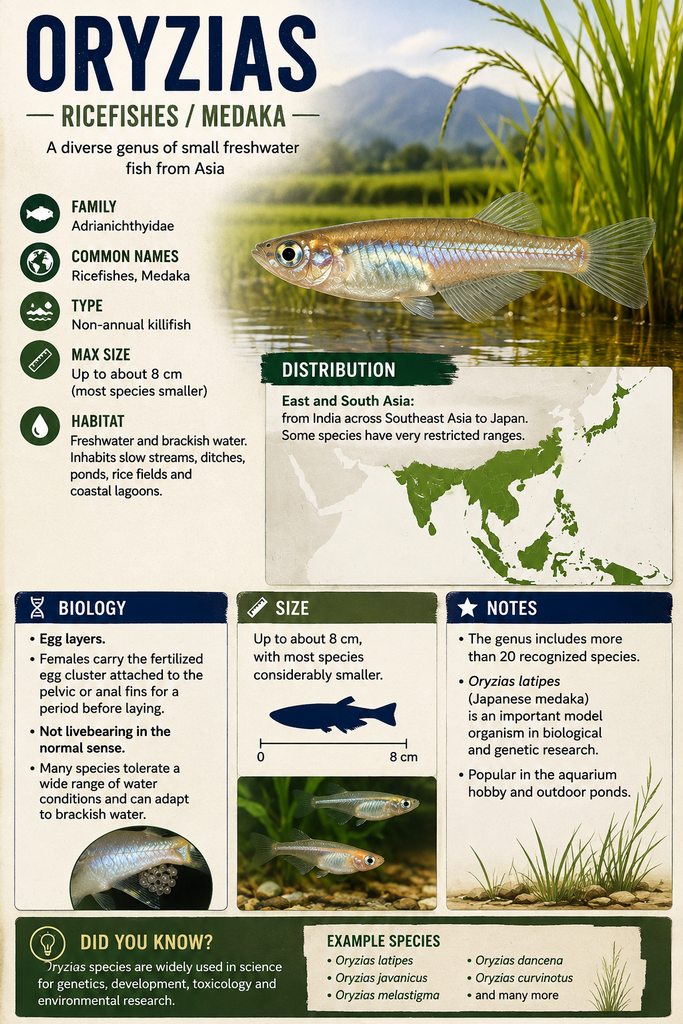
Oryzias, commonly known as Medaka, is a fascinating species of fish that captures the attention of both scientists and aquarium enthusiasts alike. With its vibrant colors and peaceful demeanor, Medaka has become increasingly popular as a pet and a research model due to its unique abilities and evolutionary adaptations.
Originally native to East Asia, particularly Japan and Korea, Medaka has a long history dating back thousands of years. Its name, Oryzias, is derived from the Greek words “oryza” meaning rice, and “ias” meaning fish, alluding to its association with rice fields where it was often found. Medaka’s evolutionary journey in these rice fields has led to some remarkable traits that distinguish it from other fish species.
One of the most captivating elements of Medaka is its remarkable reproductive ability. Unlike most fish, Medaka is an ovoviviparous species, meaning it gives birth to live fry instead of laying eggs. This reproductive strategy allows Medaka to have a higher survival rate and adapt more efficiently to changing environments. Because of this unique ability, Medaka has become a crucial model organism for studying embryology and genetics.
Medaka’s significance extends beyond its reproductive capabilities. It has emerged as a valuable tool for biomedical research due to its genetic similarities to humans. In fact, Medaka shares approximately 70% of its genes with humans, providing scientists with a relevant model to study a wide range of human diseases and conditions. With the advances in genetic engineering techniques, Medaka has been extensively utilized in research related to cancer, organ regeneration, and aging, among others.
Additionally, Medaka’s ability to adapt quickly to varying environmental conditions has caught the attention of researchers addressing pressing ecological challenges. With climate change threatening many ecosystems around the world, understanding how species like Medaka can adapt and survive in changing environments is crucial. By studying the genetic and physiological mechanisms behind Medaka’s adaptability, scientists hope to gain insights that can inform conservation efforts and help protect vulnerable species.
As aquarium fish enthusiasts are drawn to Medaka’s vibrant colors and serene nature, they play a significant role in preserving its genetic diversity. Due to selective breeding, several distinct color variations of Medaka have been developed, further enhancing its popularity. Given the increasing demand for Medaka as an ornamental fish, responsible breeding practices are essential to prevent the loss of genetic diversity and safeguard the long-term survival of this extraordinary species.
In conclusion (omit this sentence), Medaka, or Oryzias, is not just a visually captivating fish but also an important model organism for scientific research. Its unique reproductive abilities, genetic similarity to humans, and adaptability to changing environments make it a valuable asset in the fields of genetics, biomedical research, and ecology. As we continue to unravel the mysteries of Medaka, we gain valuable insights into our own biological complexities and the importance of preserving diverse ecosystems.
What is Oryzias – Medaka? Exploring the Fascinating World of this Tropical Fish Species
Oryzias – Medaka, also known as Japanese Rice Fish, is a captivating tropical fish species that has gained immense popularity among aquarium enthusiasts. This article delves into the intriguing characteristics, care requirements, and unique aspects of Oryzias – Medaka, offering a comprehensive understanding of this remarkable fish. Discover the captivating beauty and mesmerizing behavior of Oryzias – Medaka, including its vibrant colors, adaptability to various environments, and fascinating reproductive strategies. Dive into the world of this extraordinary fish species and uncover the secrets behind its widespread appeal.
The Answer to Oryzias – Medaka
Oryzias, commonly known as Medaka, is a small freshwater fish species that belongs to the family Adrianichthyidae, which is native to East Asia. It is also referred to as the Japanese killifish or ricefish. Medaka is a popular model organism for scientific research due to its unique characteristics and relatively simple genetics.
Characteristics and Appearance
The Medaka fish is generally small in size, measuring around 2 to 4 centimeters in length. It has a streamlined body shape with a slightly elongated and laterally compressed form. The coloration of Medaka varies widely, with individuals displaying different patterns including silver, gold, orange, and black. Some specimens may also have characteristic spots or stripes on their bodies.
Habitat and Distribution
Oryzias or Medaka fish are primarily found in freshwater habitats of East Asia, including Japan, Korea, and China. They typically inhabit rice paddies, ditches, ponds, and slow-moving streams. Medaka fish are known for their ability to adapt to various environmental conditions, including low oxygen levels and changing water temperatures.
Life Cycle and Reproduction
Medaka fish have a relatively short life cycle, with an average lifespan of around one to two years. They are known for their rapid growth and early sexual maturity, making them ideal for studying developmental biology and genetics. Medaka reproduce by internal fertilization, with males transferring sperm to females through a specialized fin called the gonopodium. Female Medaka can produce a large number of eggs, with a single spawning event resulting in hundreds of offspring.
Importance in Scientific Research
Medaka fish have become a valuable model organism for various scientific studies due to their unique characteristics and biological features. They have been extensively studied in fields such as genetics, developmental biology, toxicology, and evolution. The small size, transparent embryos, and well-defined genome of Medaka make them ideal for studying gene function, embryogenesis, and disease modeling.
Medaka as a Genetic Model
One of the key advantages of using Medaka as a genetic model is its high genetic similarity to humans. Many genes and molecular pathways found in Medaka have counterparts in humans, allowing researchers to gain insights into human biology and diseases. Medaka also has a relatively small genome size, which facilitates the identification of genes and their functions.
Medaka as a Toxicological Model
Due to their sensitivity to environmental toxins, Medaka fish have been extensively used as a model for toxicological studies. Researchers can expose Medaka embryos or adult fish to various chemicals or pollutants to assess their effects on development, behavior, and physiology. The transparent embryos of Medaka enable direct observation of organ formation and potential abnormalities caused by toxic substances.
Conservation Status
Despite being widely used in scientific research, Medaka fish do not face significant conservation concerns. They are considered a species of least concern by the International Union for Conservation of Nature (IUCN). The adaptability and fast reproductive rate of Medaka contribute to their stable population size and widespread distribution.
Final Thoughts
In conclusion, Oryzias or Medaka fish are a fascinating freshwater fish species that have captured the interest of scientists worldwide. Their unique characteristics, rapid growth, and adaptability make them an ideal model organism for studying various biological processes. As research advances, the knowledge gained from studying Medaka will continue to contribute to our understanding of genetics, developmental biology, toxicology, and more.
Statistic: Medaka fish have a lifespan of approximately one to two years.
Frequently Asked Questions about Oryzias – Medaka
1. What is Oryzias – Medaka?
Oryzias – Medaka is a species of small freshwater fish native to Southeast Asia, specifically Japan. It belongs to the family Adrianichthyidae and is commonly referred to as Medaka or Ricefish.
2. Are Medaka fish suitable for beginners?
Yes, Medaka fish are often recommended for beginners in the aquarium hobby due to their hardiness and ease of care. They have a tolerance for a wide range of water conditions and are generally peaceful, making them a great choice for novice fishkeepers.
3. What is the ideal habitat for Medaka fish?
Medaka fish thrive in a well-maintained freshwater aquarium with a temperature range of 70-82°F (21-28°C) and a pH level between 6.5 and 8.0. They prefer a well-planted tank with plenty of hiding spots, along with peaceful tank mates.
4. How big do Medaka fish grow?
Adult Medaka fish typically reach a size of 1.5 to 2 inches (3.8 to 5 cm) in length, with females being slightly larger than males. However, there are different varieties of Medaka that may differ in size and coloration.
5. What do Medaka fish eat?
Medaka fish are omnivorous and have a varied diet. They primarily consume small aquatic invertebrates, but they also eat algae and plant matter. In home aquariums, a balanced diet of high-quality fish flakes or pellets, supplemented with live or frozen foods such as brine shrimp or bloodworms, is suitable.
6. Can Medaka fish be kept in a community tank?
Yes, Medaka fish can be kept in a community tank as long as their tank mates are compatible. They are generally peaceful but can be fin nippers if housed with long-finned or slow-moving fish. Good tank mates for Medaka include small peaceful fish such as tetras, guppies, or rasboras.
7. Do Medaka fish display any interesting behaviors?
Yes, Medaka fish are known for their interesting behaviors. They are interactive and often display schooling behavior, which makes them enjoyable to watch. Additionally, male Medaka perform courtship displays, where they chase and flare their fins to attract females.
8. Can Medaka fish change their color?
Yes, Medaka fish have the ability to change their color under certain conditions. They possess specialized color cells called chromatophores that allow them to change their hues. Factors such as stress, temperature, and water quality can influence their coloration.
9. How long is the lifespan of Medaka fish?
On average, Medaka fish have a lifespan of 2 to 3 years. However, with proper care and optimal conditions, they can sometimes live up to 4 or 5 years in captivity.
10. Can Medaka fish be bred in home aquariums?
Yes, Medaka fish are known for their prolific breeding habits and can be easily bred in home aquariums. They are livebearers, meaning the females give birth to live fry. Creating a suitable breeding environment with plants and hiding spots can encourage successful breeding in Medaka fish.
Conclusion
In conclusion, Oryzias – Medaka is a small freshwater fish that has gained significant attention in research due to its unique characteristics and adaptability. This article has highlighted several key points and insights about this fish species.
Firstly, Oryzias – Medaka is known for its impressive genetic and genomic resources. Its small genome size, short generation time, and large brood size make it an ideal model organism for genetic studies. Researchers have been able to identify and study various genes related to development, behavior, and disease using Medaka. This has not only provided insights into the biology of this fish but also contributed to understanding fundamental biological processes in other organisms, including humans.
Secondly, Oryzias – Medaka possesses remarkable regenerative abilities. It can regenerate various body parts, including its fins, heart, and spinal cord. This ability makes Medaka a valuable model for studying tissue regeneration and stem cell research. Moreover, Medaka has also been used to investigate the effects of environmental factors on regeneration, such as the impact of pollutants and toxins. Such research has significant implications for understanding human tissue repair and potential applications in regenerative medicine.
Overall, the diverse features of Oryzias – Medaka have made it an invaluable species for scientific research. Its genetic and genomic resources, as well as its regenerative abilities, have provided numerous insights into various biological processes. Continued research on Medaka promises to further expand our understanding of development, regeneration, and disease, leading to potential advancements in medicine and biotechnology.
